

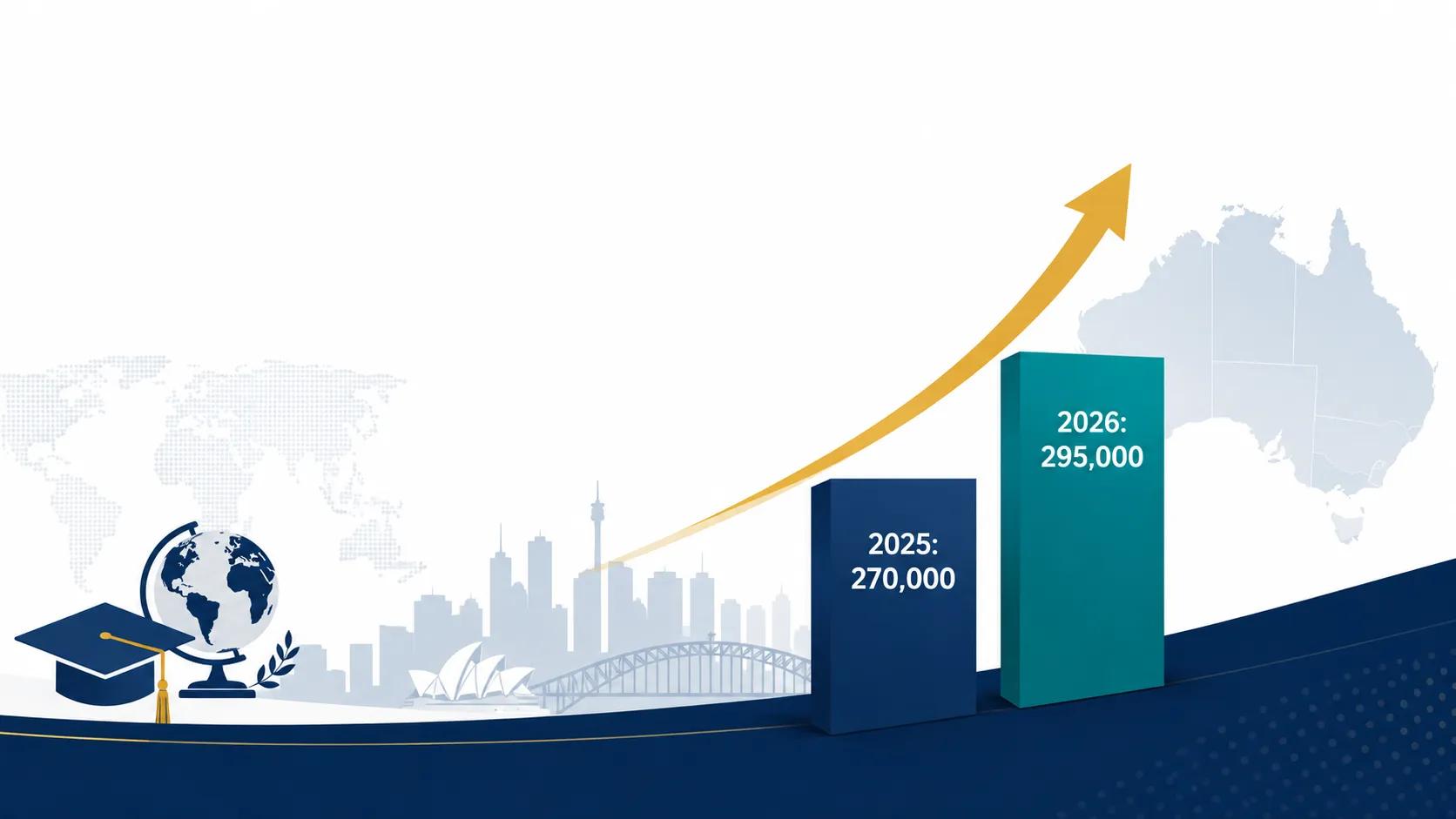
Australia is increasing its international student intake in 2026, creating fresh opportunities for students who want an overseas education. The national planning level has risen to 295,000 new international student commencements, compared with 270,000 in 2025. Yet the bigger number does not tell the whole story.
Students arriving under the new intake will face a combination of opportunities and pressures. Housing remains difficult in major cities, living costs continue to matter, and visa processing has become more selective. At the same time, university coursework still demands consistent attention.
For students planning to study in Australia 2026, success will depend on preparing for all three areas: getting into the country, managing everyday expenses and keeping up academically.
Australia's bigger intake brings new opportunities
The 295,000 target represents a 9% increase from the previous year's planning level. It suggests that Australia continues to see international education as an important part of its higher education sector.
For prospective students, more places can mean greater choice. Universities and education providers may have opportunities to welcome students from a wider range of countries and academic backgrounds.
However, the source material also highlights an important limitation. Universities seeking larger allocations must demonstrate stronger regional engagement and make progress on student accommodation. This reflects the housing pressures that have affected international students, especially in major destinations such as Melbourne and Sydney.
A student may secure admission to a preferred course and still face a difficult start if suitable accommodation is expensive or unavailable. The practical side of studying abroad can therefore shape the academic experience just as much as the classroom itself.
Planning ahead matters. Students should consider accommodation and living expenses as part of their education decision rather than treating them as problems to solve after arrival.
Visa processing requires careful preparation
The Australia student visa 2026 environment adds another consideration for prospective students. According to the source, rejection rates for several major source countries increased during the first half of 2026.
Priority processing has also favoured certain cohorts, including Southeast Asian applicants, Pacific and Timor-Leste students, and scholarship holders. Other applicants may experience longer waits.
This creates a more complicated path from university acceptance to arrival. Students cannot assume that receiving an offer automatically means every remaining step will move quickly.
The changing visa environment also explains why prospective students need to pay attention to current requirements and prepare their documentation carefully. Delays can affect accommodation plans, travel arrangements and the start of a student's academic journey.
The larger policy picture matters too. Australia's education system is trying to balance international demand with housing capacity and institutional resources. The result is a system where student numbers, accommodation and visa processing are increasingly connected.
The academic workload starts after the visa is approved
One of the most useful observations in the source is that international students often identify cost of living and housing as their leading concerns, rather than academic difficulty.
That does not make academic workload unimportant. In fact, financial pressure can make coursework harder to manage.
Imagine a student who spends the first few weeks in Australia searching for affordable housing, adjusting to transport costs and managing a limited budget. By the time a major assignment arrives, much of the student's attention has already been consumed by everyday problems.
Academic support can help reduce some of that pressure. Students may need assistance understanding unfamiliar assessment requirements, organising research or approaching difficult subjects.
For example, someone studying information systems may need to connect technical concepts with business strategy rather than simply describe a textbook definition. A resource such as Expertsmind’s information systems strategic planning material can provide useful academic context when exploring the relationship between information systems and strategic planning.
The goal should be better understanding, not a shortcut around learning. When students understand how an assessment works, they can spend more time developing their own arguments and less time figuring out where to begin.
International students need more than subject knowledge
Academic success also depends on knowing how to apply theories to real situations.
Business students provide a clear example. An assignment about competitive strategy may require more than definitions of different strategic approaches. Students may need to examine a company's position, connect theory to evidence and explain why a particular strategy makes sense.
A practical reference such as Expertsmind’s competitive strategy assignment resource can help students see how strategic ideas may be developed within an academic discussion.
This kind of support can be particularly useful for students who are adjusting to a new academic system. Expectations around structure, analysis, referencing and critical discussion may differ from what students experienced in their home countries.
The same principle applies across disciplines. An engineering student may need to apply a technical model to a practical problem. An IT student may need to explain the business impact of a technology decision. A management student may need to turn several theories into one coherent argument.
Knowing the subject is only part of the task. Knowing how to communicate that knowledge matters too.
Turning a larger intake into better outcomes
Australia's 2026 international education settings create a clear contrast. More students are being given the opportunity to begin an Australian education, while the surrounding conditions remain challenging.
The increase to 295,000 new international student commencements is significant, but student success cannot be measured by intake numbers alone. Housing, living costs, visa processing and academic workload all influence what happens after arrival.
The source also indicates that similar intake levels may remain under consideration for 2027, alongside continued attention to visa processing and accommodation capacity. That makes the current experience relevant beyond one academic year.
For prospective students, the practical lesson is straightforward. Choosing a course and receiving an offer are only the first steps. Students also need a realistic budget, awareness of visa requirements and a plan for handling university coursework.
Australia remains an attractive destination for international education, but the experience requires preparation. The students most likely to benefit from the expanded opportunities will be those who prepare not just to arrive, but to succeed once they are there.
The number of available places may open the door, but preparation determines what happens after students walk through it.