

F1
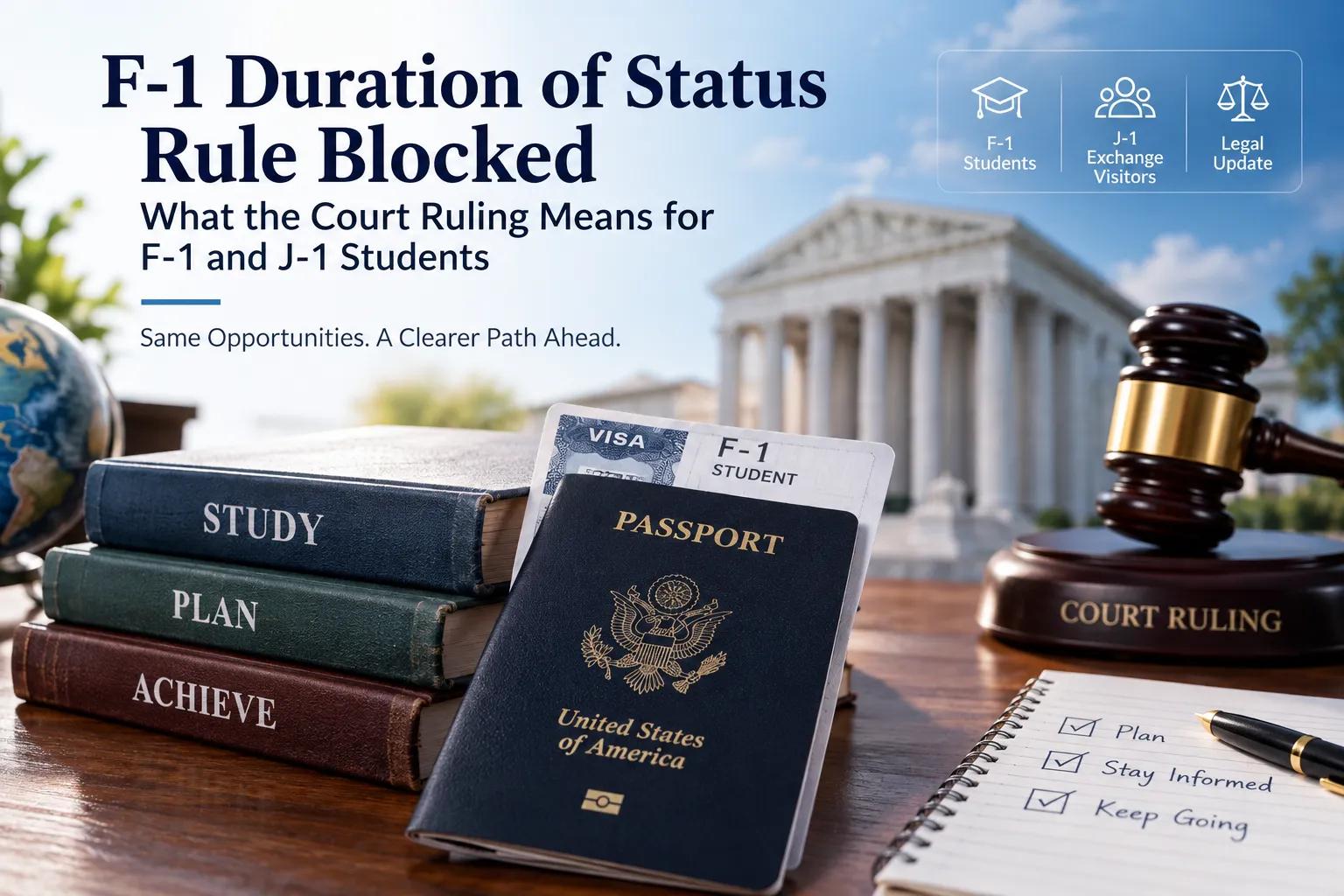
The F-1 duration of status rule was set to change the way international students remain in the United States. Then, just one day before the planned September 15, 2026 start date, a federal judge in Massachusetts issued a nationwide preliminary injunction blocking the rule while the legal challenge continues. For F-1 students, J-1 exchange visitors and their dependents, the immediate result is straightforward: the existing duration-of-status system remains in place for now. Students do not suddenly face a four-year admission limit, and the new extension-of-stay requirement did not take effect.
But this is a pause, not the end of the issue. The lawsuit is still moving forward, and the government may appeal. That makes understanding both the current rules and the proposed changes worthwhile.
Why the Duration of Status Rule Matters
Under the existing system, eligible F-1 students are generally admitted for “duration of status,” commonly shown as D/S on immigration records. This means their authorized stay is connected to maintaining their student status and making normal progress toward their academic objective rather than simply reaching a fixed departure date. J-1 exchange visitors operate under a similar framework.
The DHS rule published in July 2026 proposed replacing that arrangement with fixed admission periods. For most F-1 and J-1 students, the period would generally have been capped at four years.
That distinction matters most for students whose programs do not fit neatly into a four-year timetable. Doctoral research, for example, can stretch beyond four years because a dissertation may require additional research, experiments or revisions.
Under the proposed system, a student needing additional time would generally have needed to seek an extension from USCIS rather than relying on the existing D/S framework. The rule also proposed reducing the F-1 post-completion grace period from 60 days to 30 days and introducing additional restrictions involving transfers, changes in educational objectives and additional degrees.
What the Court's Injunction Changes
The September 14 order stopped DHS from implementing the rule while the litigation proceeds. The nationwide scope means the decision is not limited to the universities or organizations involved in the lawsuit.
For students, several practical consequences follow.
The four-year maximum has not taken effect. Students admitted under D/S remain under the existing framework. The proposed USCIS extension requirement also did not begin on September 15.
The existing 60-day F-1 post-completion grace period remains available rather than being reduced to 30 days under the blocked rule. Restrictions that were part of the new system also remain on hold.
The court's reasoning is also significant. Judge F. Dennis Saylor IV found that the plaintiffs were likely to succeed on claims that DHS had not adequately addressed the rule's costs and benefits, considered less burdensome alternatives, or responded sufficiently to significant public comments. The court also questioned whether DHS had adequately connected the rule to its stated objectives.
That does not mean the court permanently rejected the policy. The injunction is preliminary, and the underlying case continues.
What International Students Should Do Now
The current situation gives students time, but it does not remove the need for planning. Your first step should be a conversation with your designated school official, especially if your degree could take more than four years.
Ask how your current program timeline interacts with your immigration record and what the university would recommend if the fixed-period system eventually returns. A DSO cannot predict the court's final decision, but they can identify potential issues in your individual record.
Keeping documents organized is another simple step. Students should retain copies of their I-20 or DS-2019, I-94, enrollment records and relevant travel history. If an extension or other filing becomes necessary later, having these records readily available can reduce unnecessary delays.
Academic planning matters too. A student who is already balancing research, assignments and a demanding course schedule may benefit from additional academic guidance. For literature reviews, research-heavy coursework or complex academic projects, Expertsmind's literature review assignment help can provide subject-focused support alongside advice from university faculty.
The goal is not to rush your studies because of the blocked rule. It is to understand your timeline well enough to make informed decisions if immigration requirements change again.
What Could Happen to the Rule Next?
Several paths remain possible. The government could appeal the preliminary injunction. The appellate court could leave the injunction in place, modify it or allow implementation to proceed.
The district court case could also continue toward a final decision. Because the September ruling focused on the government's rulemaking process, rather than permanently declaring the policy invalid, the possibility of further action remains.
There is also a possibility of revised rulemaking. If DHS attempts to address the procedural concerns identified by the court, a future version could look different from the rule that was blocked.
For students, that uncertainty makes reliable information more useful than social media speculation. Immigration policies can affect enrollment decisions, academic timelines and work plans, so students should follow updates from their university's international office, official government sources and organizations tracking the litigation.
For those preparing research projects or trying to understand the policy's broader academic implications, Expertsminds' research paper support resource can also be useful when developing research-based coursework.
The clearest takeaway is simple: the duration of status system has not been replaced yet. The injunction preserves the existing framework while the legal case continues, but it does not guarantee that the proposed changes are gone permanently. Students who know their academic timeline, maintain clean records and stay connected with their DSO will be better prepared for whatever comes next.